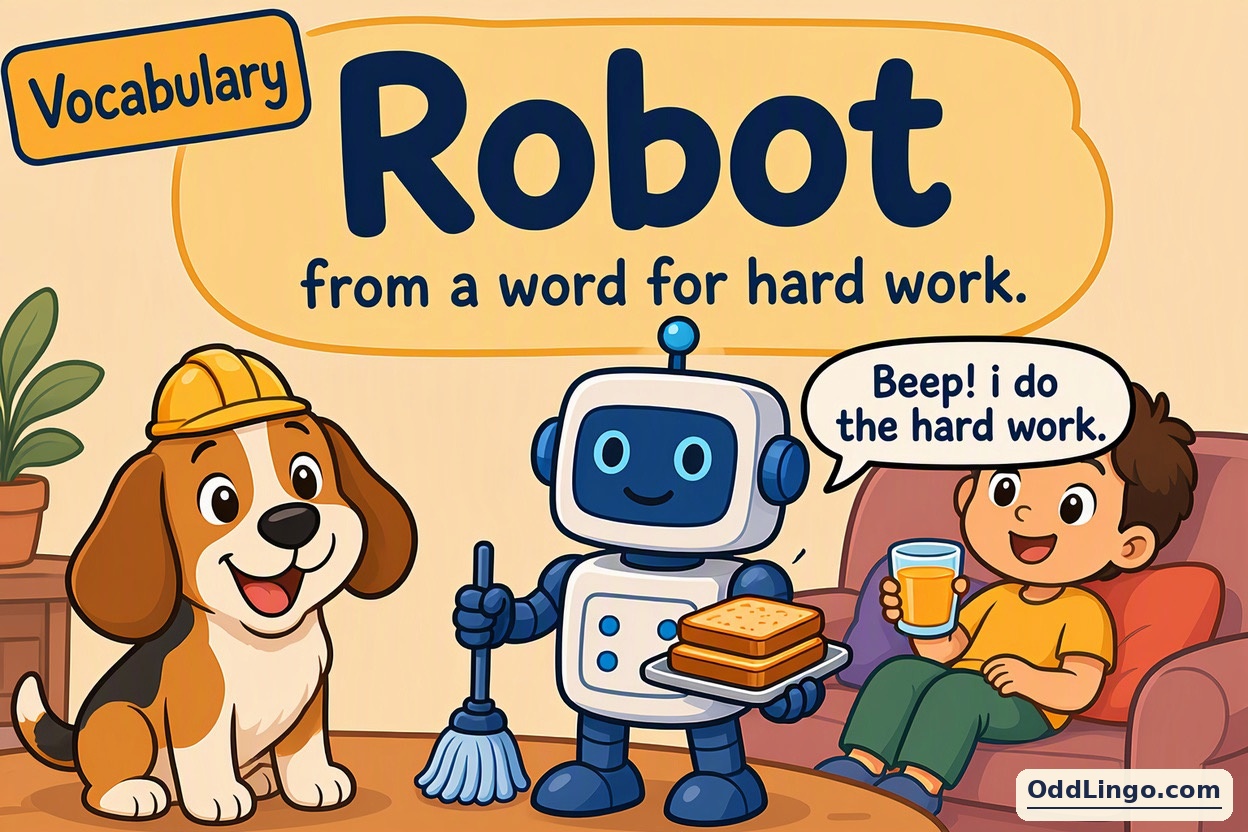
A robot is a machine that can do tasks by itself, such as vacuuming, building cars or answering questions. The word is only about a hundred years old, and it first appeared in a play.
Wait... Who Invented "Robot"?
Robots feel like they've been around forever, but the word is a young one. It wasn't made up by a scientist in a lab. It was made up for a play, by a Czech writer, about a factory that makes artificial workers.
Old word? ❌
Invented for a play? ✅
What Does Robot Mean?
A robot is a machine that's built to do jobs, often jobs that people find boring, hard or dangerous. Some robots look like machines with arms. Some look like toys, dogs or vacuum cleaners. Some are only software.
My cousin built a robot that can pour a glass of juice, but only if you stand very still.
🔊 Pronunciation
ROH-bot
The stress is on the first part: ROH. The second part is short, like "bot" in bottle. Don't say ro-BOT.
🗣️ Natural Examples
My little brother thinks our robot vacuum is a pet, and he has named it Gary.
The robot at the school contest could build a tower, but it couldn't climb the stairs.
Dad talks in a robotic voice whenever the printer stops working.
A real robot has never once finished my homework. I checked.
In the story, the robots went on strike, and the humans had to make their own toast.
🛠️ How to Use It
Robot is a very common, everyday word. You can use it in conversation, in school writing and in stories.
- It's countable: a robot, two robots.
- It works for real machines and for characters in stories and films.
- You can use it as a describing word too, as in a robot dog or a robot arm.
🤝 Common Word Partners
- a robot vacuum
- a robot arm
- a toy robot
- build a robot
- a robot competition
- a robot dog
👨👩👧 Word Family
- robotic (adjective): it can mean "like a robot", or it can describe a stiff, flat way of moving or talking. She spoke in a robotic voice.
- robotics (noun): the study and building of robots. He joined the school robotics club.
👯 Similar and Related Words
- machine: any device that does work. Every robot is a machine, but not every machine is a robot, because a robot does tasks on its own.
- android: a robot that looks like a person.
- bot: a short form of robot, often used for software, such as a chatbot.
⚠️ Common Mistakes
Which part gets the stress? The first part.
❌ ro-BOT
✅ ROH-bot
Robot, robotic or robotics?
❌ He is studying robotic at school.
✅ He is studying robotics at school. / He walks in a robotic way.
💬 In a Conversation
Mia: Dad says the word "robot" is only about a hundred years old.
Sam: No way. Robots feel much older than that.
Mia: A Czech writer used it in a play in 1920, and then it took over the world.
Sam: So what did people call a robot before that?
Mia: Probably "that weird machine that won't tidy my room."
🕵️ Where Does It Come From?
The word robot was spread around the world by a play called R.U.R. by the Czech writer Karel Čapek. It was written in 1920, and the first performance was in 1921. (Sources give one date or the other.) The letters stand for Rossum's Universal Robots. In the play, a factory makes artificial people to do work for humans, and Čapek called them roboti.
The word comes from the Czech word robota, which means hard, forced work. Čapek said that it was his brother Josef who came up with the word. Karel had first thought of labori, from Latin labor, "work", but it sounded too bookish.
There's one more twist. The word robotics was first recorded in a short story by the writer Isaac Asimov in 1941. Asimov seems not to have realised he was creating a new word. He thought it already existed.
💡 The OddLingo Trick
Think of robota as "hard work". A robot is a worker that does the hard work, so people don't have to.
So every time you see a robot vacuum, a robot arm or a toy robot, remember the old Czech word underneath: work.