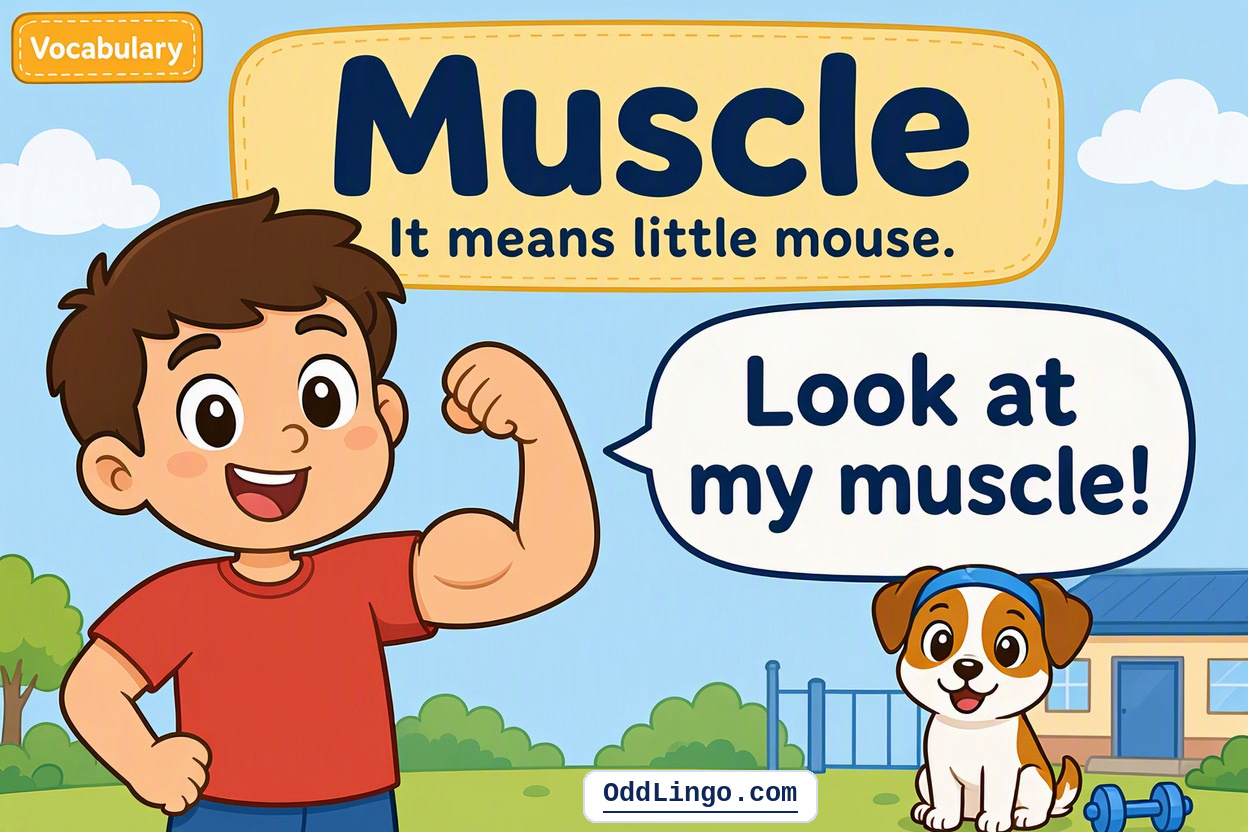
A muscle is the part of your body that tightens and relaxes to make you move. The word comes from a Latin word that means "little mouse", and the C in it is silent.
What Does Muscle Mean?
A muscle is a kind of body tissue that tightens and relaxes to move a part of your body. Your arms, legs, heart and even your eyes use them.
It can also mean physical strength (She has plenty of muscle) and, in a looser way, the power to make others do what you want (The big company used its muscle).
I flexed my arm to show off my muscle, and the dog was not impressed.
Here's the oddest part: the word comes from mouse. A muscle moving under the skin was imagined to look like a mouse running about, which is why English kept a "mouse" word in your arm.
🔊 Pronunciation
MUSS-ul
The stress is on the first part: MUSS. The C is silent. Don't say MUS-kul.
It sounds just like mussel, the shellfish. The two words are spelled differently but said the same.
Silent letters are everywhere in English. If you like them, try Why Is There a B in "Doubt"?.
🗣️ Natural Examples
My grandpa says carrying the shopping builds muscle, so he lets me carry it all.
Every muscle in my legs complained after the school run.
The cat froze, and not one muscle moved, until the bird flew away.
I want to build muscle, but I keep stopping for snacks.
The seagulls muscled in on our picnic and took all the chips.
🛠️ How to Use It
Muscle is a common, everyday word. You can use it in conversation, in school, and in writing about health and sport.
- It's countable when it means one part of the body: a muscle, two muscles.
- It's usually uncountable when it means strength: She has plenty of muscle.
- It's also a verb in the phrasal verb muscle in, which means to force your way into something that you were not invited into.
🤝 Common Word Partners
- flex a muscle
- build muscle
- muscle mass
- muscle fibre
- muscle tissue
- strong muscles
- muscle in (on something)
🌳 Word Family
- muscular (adjective): relating to muscles, or having large, strong muscles. A muscular swimmer.
- muscle in (phrasal verb): to push into a situation uninvited. Don't muscle in on our game.
Here's another twist: in muscular, the C is pronounced: MUS-kyuh-ler. In muscle, it's silent.
👯 Similar and Related Words
- strength: the quality of being strong. A muscle is a body part, and strength is what it can do.
- biceps: a particular muscle at the front of your upper arm. It's one of the muscles that people long ago thought looked like a mouse.
- mussel: a shellfish that sounds the same as muscle. The spelling is different, so the meaning is too.
⚠️ Common Mistakes
Sounding the C. In muscle, the C is silent.
❌ MUS-kul
✅ MUSS-ul
Mixing up muscle and mussel. They sound the same, but the meanings are very different.
❌ I flexed my mussel.
✅ I flexed my muscle. / We cooked mussels for dinner.
Muscle or muscular? One is a noun, the other is an adjective.
❌ He is very muscle.
✅ He is very muscular. / He has a lot of muscle.
💬 In a Conversation
Sam: My arm muscle is the size of a mouse.
Mia: That's actually a good start. Did you know the word muscle means "little mouse"?
Sam: So my arm has a little mouse?
Mia: A very quiet one.
Sam: I'll call him Gary.
🕵️ Where Does It Come From?
The word muscle comes from the Latin word musculus, which literally means "a little mouse". It is a small form of mus, the Latin word for "mouse".
The reason is a funny picture. Some muscles, especially the biceps in your upper arm, were thought to look like a mouse in shape and movement. The ancient Greeks had the same idea: their word mys meant both "mouse" and "muscle".
The word has been used in English for the body part since the late 1300s. The spelling still keeps the C from the Latin word, even though we don't say it.
💡 The OddLingo Trick
Make a muscle and watch your arm. Something small moves under the skin, like a little mouse.
For the spelling, remember: the C is hiding, just like a mouse under a blanket. You can't hear it in muscle, but you can hear it in muscular.