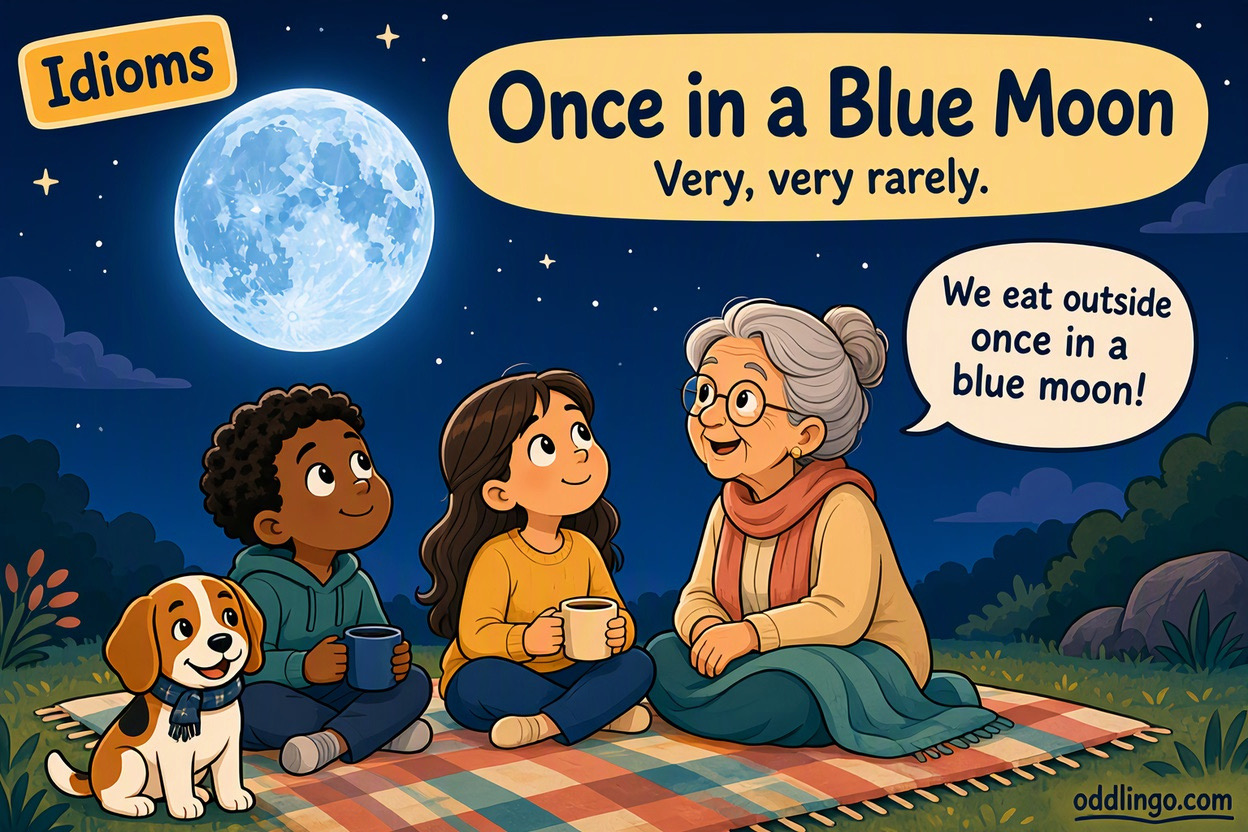
⚡ Quick Meaning
If something happens once in a blue moon, it happens very, very rarely.
We eat dinner outside once in a blue moon, because it's usually too cold.
It's an everyday way to say "almost never".
🌙 Wait... a Blue Moon?
ONCE IN A BLUE MOON = VERY RARELY?!
A moon that is actually blue? ❌ (not usually!)
Something that hardly ever happens? ✅
When we say this, nobody is looking up at a blue moon. The moon is just a picture for "this doesn't happen often". A blue moon is rare, so something that happens "once in a blue moon" happens about that rarely.
It's also a fixed phrase. We say once in a blue moon, not "twice in a blue moon" or "once in a green moon".
🎬 Picture the Situation
Your uncle lives far away, so you only see him on very special days. At the end of the visit, he says, "I only get to see you once in a blue moon. Next time, let's stay longer!"
🗣️ Natural Examples
My cousin visits us once in a blue moon, so we always make a big dinner.
Once in a blue moon, our teacher lets us have class outside.
I don't eat candy much. Only once in a blue moon.
It snows here once in a blue moon, so everyone runs outside.
💬 In a Conversation
Mia: Does Grandpa ever beat you at chess?
Dad: Once in a blue moon, yes.
Mia: So... almost never?
Dad: Almost never. But he still wants a rematch every time.
🧭 When Do You Use It?
- Something happens very rarely, but it does happen sometimes
- You want to say "hardly ever" in a more colourful way
- You are chatting with friends or family
- You are telling a story about something unusual
🎓 Common Learner Point
It means very rarely, not never. Once in a blue moon, it does happen. If something never happens, say never.
Don't use it for things that happen often. If your football team practices every Tuesday, that is every week, not once in a blue moon.
It's informal. It's great for chatting or storytelling. In a school report, you could write rarely or very seldom instead.
The phrase can also start the sentence. Once in a blue moon, we eat out. This sounds a little more dramatic.
🔭 Is There a Real Blue Moon?
Yes, there are two kinds. Neither one is the reason for the idiom, but they're fun to know.
- The calendar blue moon. Most months have one full moon. Sometimes a month gets two, and many people call the second one a blue moon. It happens about once every two or three years. This meaning became popular only in the 1900s, after a magazine explained it in 1946.
- A moon that really looks blue. It's rare, but it has happened. After the Krakatoa volcano erupted in 1883, dust in the sky made the moon look blue in many places for a long time. Smoke from huge forest fires in Canada did the same thing in 1950.
So the moon can be blue. It just almost never is. That's the OddLingo twist: the idiom turned out to describe something that really is rare!
🕵️ Where Does It Come From?
The idiom is older than the calendar meaning.
- People used to say once in a moon, which meant "once a month" or "now and then". A written example from 1547 says ones in a mone.
- In 1821, a writer used blue moon to mean a long time. By 1833, a magazine called The Athenæum printed once in a blue moon.
- Blue may have been added to make the phrase sound more unusual. A slang dictionary in 1890 compared a blue moon to something that doesn't exist, so the phrase first meant "almost never".
Nobody knows exactly why blue was chosen. It's a good reminder that English likes colourful words, even when we can't explain them.
💡 The OddLingo Trick
Picture a calendar with one tiny moon painted bright blue. It's so special that everyone stops to look.
If something happens all the time, you say every day. If it's at the other end of the scale, it's once in a blue moon. If it only happens a few times in a long, long while, you can use this idiom.
If it basically never happens, try when pigs fly. You might also like the weather idiom raining cats and dogs. Both are wild pictures that mean something simple.