⚡ Quick Meaning
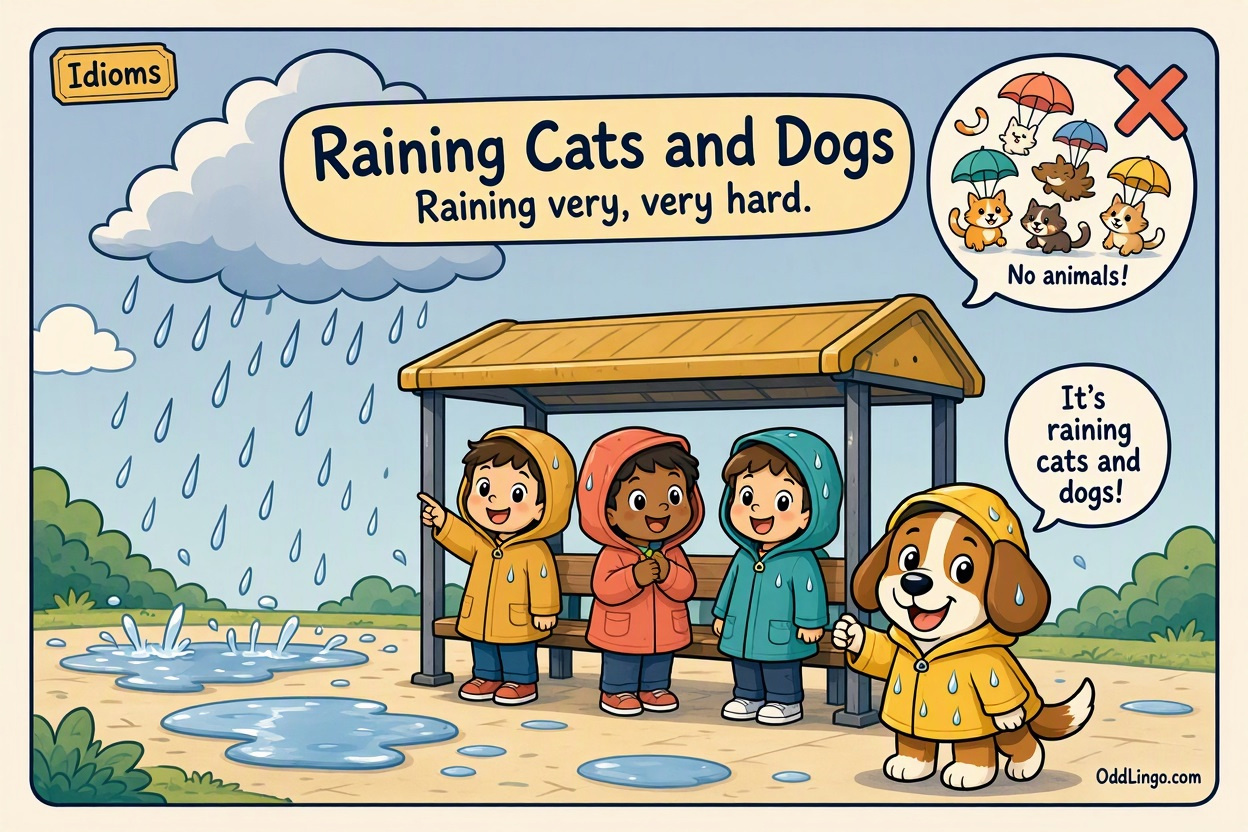
If it's raining cats and dogs, it's raining very, very hard.
"Take an umbrella. It's raining cats and dogs out there!"
It's an informal, everyday way to describe a heavy downpour. No animals are involved.
🐱 Wait... Cats and Dogs?
RAINING + CATS + AND + DOGS = A HEAVY DOWNPOUR?!
Animals falling from the sky? ❌
Rain falling very hard? ✅
If you take the words literally, the picture is silly: puppies and kittens tumbling out of the clouds. The idiom borrows that wild, over-the-top image to say "this is not a little drizzle."
It's also a fixed phrase. The order is always cats and dogs. Nobody says "raining dogs and cats."
🎬 Picture the Situation
You walk out of school with no umbrella. Five minutes earlier the sky was bright blue. Now the rain is bouncing off the pavement, and everyone is running for the bus shelter.
"Wow," says your friend. "It's raining cats and dogs!"
🗣️ Natural Examples
We wanted to play football after school, but it was raining cats and dogs.
It rained cats and dogs all through the picnic, so we ate our sandwiches in the car.
"Is it still raining cats and dogs?" "Yes. Stay inside for now."
The forecast says it will rain cats and dogs tomorrow morning.
💬 In a Conversation
Mia: Are we still going to the park?
Dad: Look outside. It's raining cats and dogs.
Mia: So... board games?
Dad: Board games.
🧭 When Do You Use It?
- The rain is much heavier than normal
- You want to explain why plans have changed
- You are chatting casually with friends or family
- You want to make a weather comment more playful
🎓 Common Learner Point
Use it for heavy rain only. A light shower is not "raining cats and dogs." For a gentle rain, say it's drizzling. For something heavier, it's pouring works too, and it sounds a little less dramatic.
It only describes rain. Do not use it for other things that come in large numbers, like homework.
Keep it informal. It's perfect for chatting, but a weather report or a school science report would use words like heavy rain or downpour.
🕵️ Where Does It Come From? Nobody Knows
This is the OddLingo part: the real origin of this idiom is a mystery.
What we can say is a short list of facts:
- A comedy by the playwright Richard Brome, written by about 1652, has a character say it will "rain dogs and polecats." That's a close cousin of our phrase, though a polecat isn't a cat.
- In 1738, Jonathan Swift wrote it would rain cats and dogs in a book called Polite Conversation. The Oxford English Dictionary lists this as the earliest written use of the modern wording.
- Swift's book made fun of overused, worn-out phrases. So the idiom was probably already a well-known cliché by then. Swift most likely didn't invent it.
That means the first record of raining cats and dogs may be a joke about a phrase people were already tired of hearing.
The popular stories
You may have heard these:
- Cats and dogs used to sleep on thatched roofs, and heavy rain washed them off.
- Heavy rain used to sweep animals down the street.
They make good stories, but there's no solid evidence for either one, so treat them as folklore. One more careful idea is that a storm is loud and wild, like a cat and dog fight, so the animals became a way of describing the chaos. That's a theory too, not a proven fact.
💡 The OddLingo Trick
Picture the weather forecaster holding up a sign: "Heavy rain today. No actual pets will fall."
If you can't tell how strong the rain is, ask yourself: would I need an umbrella and a very good excuse to stay inside? Then it's cats and dogs.
If you like weather words, you can also read about petrichor, the smell of rain on dry ground, or other weather idioms such as a storm in a teacup and feeling under the weather.