⚡ Quick Meaning
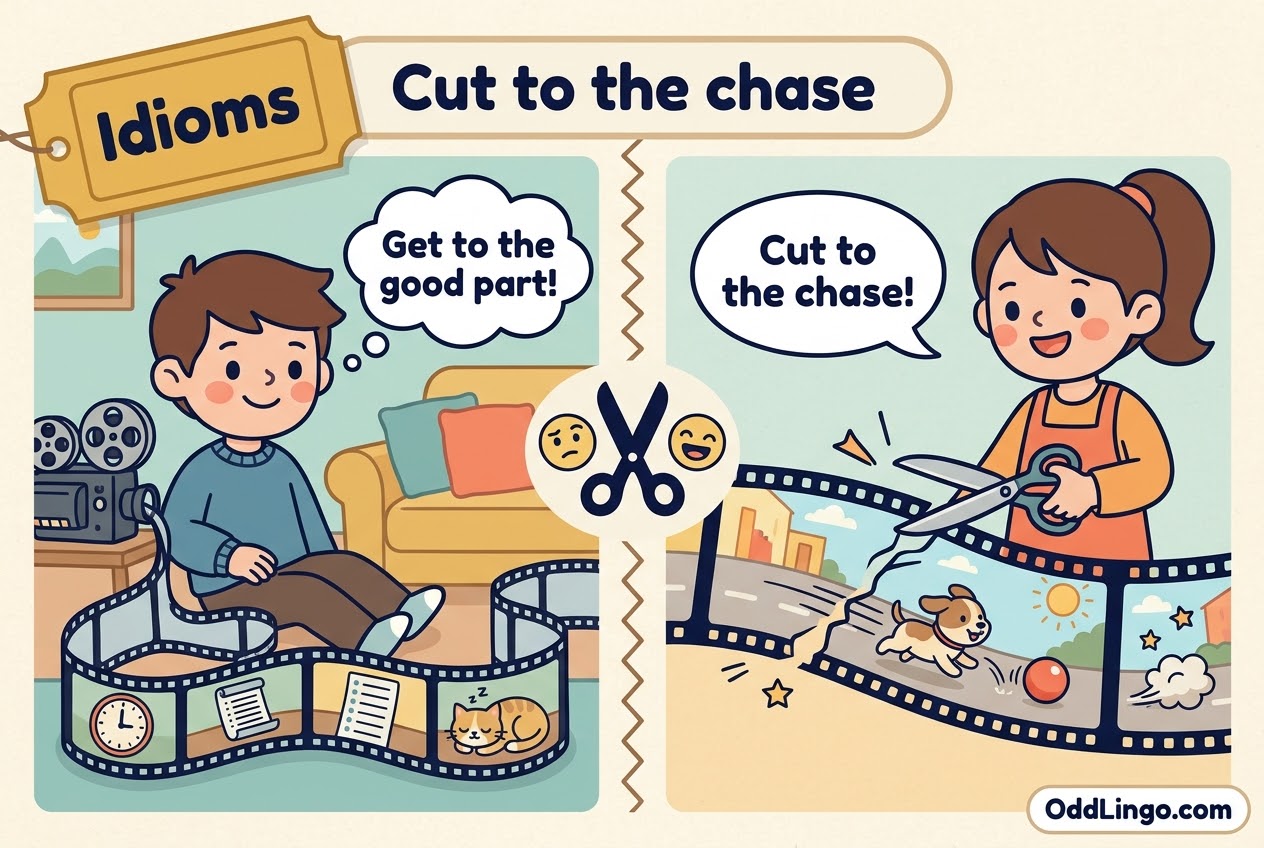
If you cut to the chase, you skip the long, slow part and go straight to the most important point.
🎞️ Wait... What Chase?
CUT + TO + THE + CHASE
Is someone running after somebody? ❌
Is anyone cutting anything with scissors? ❌
Is it a picture for "get to the exciting part"? ✅
The words come from the cinema. In a film, a cut is the moment when the picture jumps to a new scene. So to cut to the chase is to jump straight to the exciting bit, and leave out the waiting around.
🎬 Picture the Situation
Leo wants to ask for a bigger allowance. He talks about the weather, the cat, the price of bread and his maths homework.
Mum puts down her tea. "Leo, let's cut to the chase. What do you want?"
"Ten more coins a week, please."
🗣️ Natural Examples
Let's cut to the chase: who ate the last biscuit?
The teacher cut to the chase and told us the test date.
My uncle's story took ten minutes, so I asked him to cut to the chase.
To cut to the chase, our robot works. It just does not like Mondays.
💬 In a Conversation
Mia: So, first I found my shoe, then I lost my other shoe, then I found a sock...
Sam: Mia, cut to the chase. Are we late?
Mia: Very.
Sam: Thank you. Now put on both shoes.
🧭 When Do You Use It?
- When you want to skip the introduction and say the main thing
- When you ask someone else to hurry up and get to the point
- To start a clear explanation: To cut to the chase, ...
- It is casual and friendly. With a teacher or a boss, Could you get to the point? sounds softer.
⚠️ Common Mistakes
It is cut, not cat or cuts.
❌ Let's cat to the chase.
✅ Let's cut to the chase.
Use to, not for.
❌ Let's cut for the chase.
✅ Let's cut to the chase.
It is not about running.
❌ The dog cut to the chase after the ball.
✅ The dog chased the ball.
🕵️ Where Did It Come From?
It most likely comes from film-making. Film directors and editors cut from one scene to another. A chase scene, with running and fast action, is often the most exciting part of a film, so cut to the chase meant "stop the slow scene and show the exciting one."
The first examples found so far are from the film world.
- 1929: a book about Hollywood uses cut to the chase in its real, literal film sense.
- 1934: a newspaper describes a sign in a film studio boss's office that said "Cut to the chase!"
- 1940s: people start using it in the everyday sense we use today.
Before that point it was a job for film people. After it, anyone could use it, even when there was no film and no chase.
The earliest evidence is from film, but the exact first use is still unknown, so earlier ones may be hiding somewhere.
💡 The OddLingo Trick
Imagine the film of your life. The boring part is the slow scene where somebody talks about socks. Now press the cut button, and the screen jumps to the exciting bit.
That jump is cut to the chase.
Related: the opposite is beat around the bush. A cousin is make a long story short, and another short one is in a nutshell. Do not mix it up with a wild goose chase, which is a very different chase!