⚡ Quick Meaning
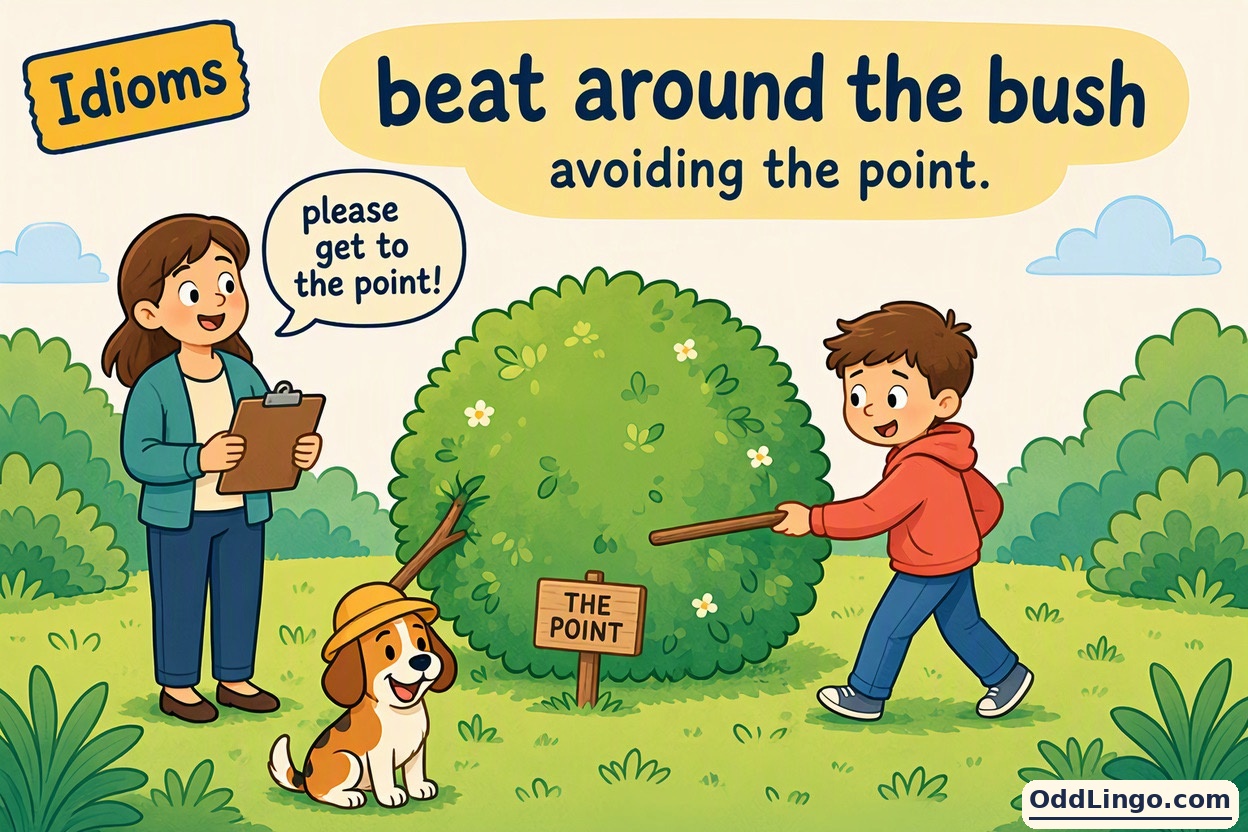
If you beat around the bush, you talk about everything except the main point, because you're avoiding it.
"Did you eat the last cookie?" "Well, the weather was lovely today, and..." "Don't beat around the bush!"
It's an everyday way to say someone isn't being direct.
🌿 Wait... Beat? A Bush?
BEAT + AROUND + THE BUSH = AVOID THE POINT?!
Hitting a bush? ❌
Not getting to the point? ✅
Nobody is attacking a plant. In this idiom, beat doesn't mean hit someone or win a game. It's an old hunting word that means to tap bushes to scare out whatever is hiding inside.
So beating around the bush means tapping the edges of the bush, but never getting to the middle where the action is. That's exactly what a person does when they talk and talk but never say the thing.
Both around and about are used. Beat about the bush is more British, and beat around the bush is more American. The meaning is the same.
🎬 Picture the Situation
Your teacher asks who forgot to hand in the homework. One friend starts a long story about the bus, the rain and a missing pencil case. After a minute, the teacher smiles and says, "Please don't beat around the bush. Just tell me."
The friend takes a deep breath. "I forgot my homework."
🗣️ Natural Examples
My brother beat around the bush for ten minutes before he asked for pocket money.
Stop beating around the bush and tell us who won the game!
She didn't beat around the bush: "I think we should say sorry."
Why are you beating about the bush? Just ask her to the party.
💬 In a Conversation
Mum: You've been very quiet. Is something on your mind?
Leo: Well... you know how the weather is nice, and the garden looks lovely...
Mum: Leo, you're beating around the bush.
Leo: I broke the flowerpot.
🧭 When Do You Use It?
- Someone is talking and talking but avoiding the real point
- You want someone to be more direct
- Someone is nervous about sharing bad (or surprising) news
- You are describing your own habit of taking too long to say something
You usually hear it as a request: Don't beat around the bush.
🎓 Common Learner Point
Use around or about, not at or on.
❌ Don't beat at the bush.
✅ Don't beat around the bush.
It can sound impatient. Don't beat around the bush! is fine between friends, but it can sound a bit blunt to a teacher or someone you don't know well. A politer choice is Could you tell me directly?
It's about words, not actions. You beat around the bush when you talk. You don't use it for someone who is simply slow at doing something.
🕵️ Where Does It Come From?
Here's the part that gives the idiom its picture.
- Long ago, bird hunters used beaters. Their job was to hit bushes and undergrowth with sticks, to scare birds and other small animals out so the hunters could catch them.
- The phrase is old. It's often traced to a medieval poem called Generydes from around 1440, though the spelling is very different from ours. Dictionaries also record uses from the 1500s.
- Over time, it came to mean spending time on the edges of something without going into the middle. By the 1500s, people were using it for being evasive in conversation.
There's a popular story that beaters were scared of what might jump out of the thicket, so they only tapped the edges. It makes a good tale, but there's no solid evidence for it, so treat it as a fun guess.
💡 The OddLingo Trick
Imagine a person with a long stick, tapping all around a big bush but never touching the middle. Meanwhile, a hunter waits. Everyone is waiting for the point.
Edges = talking around it. Middle = the point. If you want to get to the middle, say the main thing first.
The opposite is to hit the nail on the head, which means saying exactly the right thing. And if you like idioms from hunting, try barking up the wrong tree.