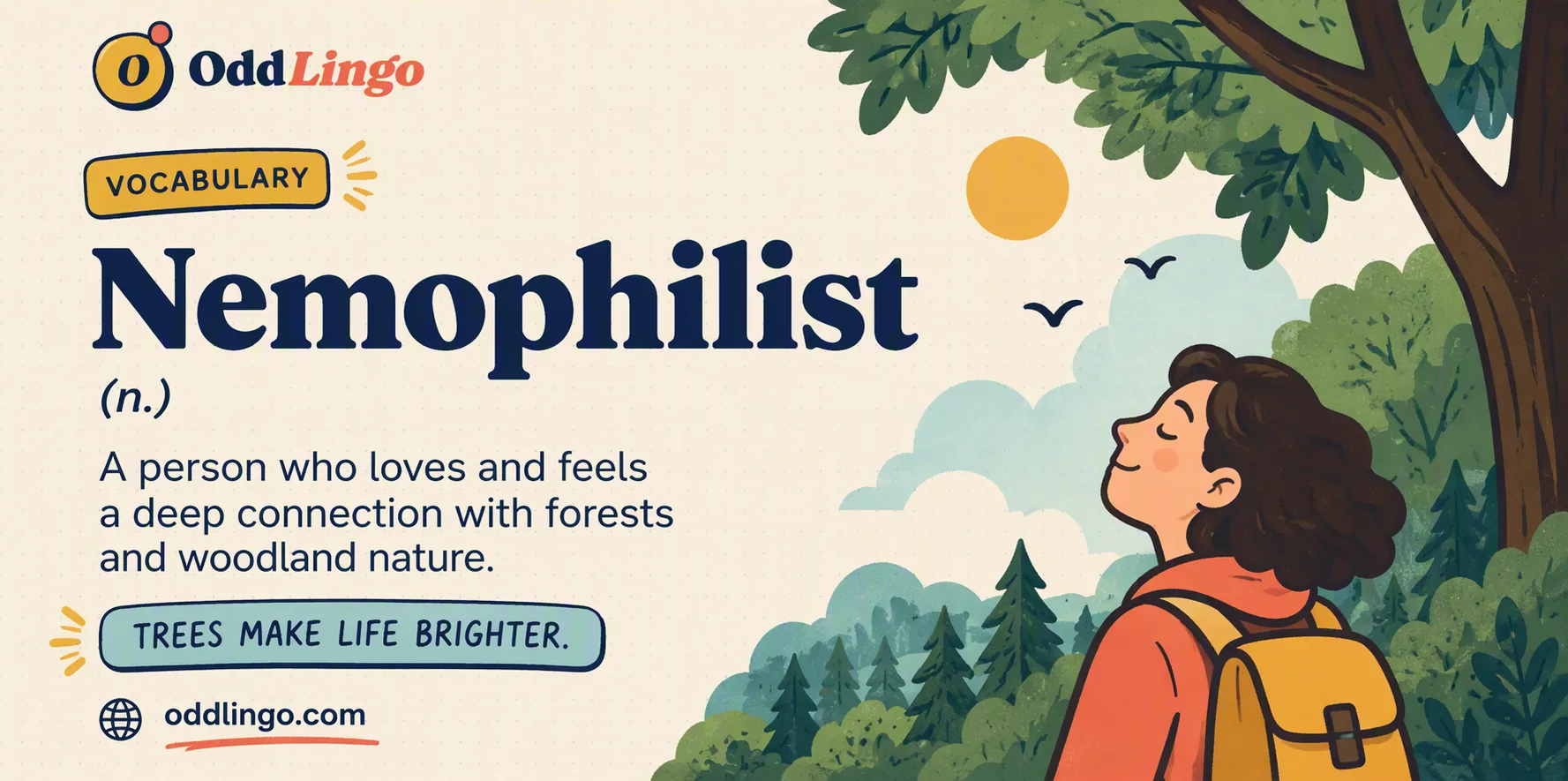
A nemophilist is someone who loves forests, woods, or forest scenery — not just someone who tolerates a walk in the woods, but someone who's genuinely drawn to them.
Wait... a Nemo-What?
"Nemophilist" looks like it should mean something from a Pixar movie. It doesn't. The word has nothing to do with a small orange fish. Once you break it apart, the mystery clears up fast: it's simply an impressively Greek-looking way of saying "forest lover."
Apparently I'm a nemophilist. I thought I just liked trees.
What Does Nemophilist Mean?
If you're a nemophilist, you love spending time in forests, and you feel calm, happy, or at home among trees. It describes a person, not a place or a feeling — you can be a nemophilist, but a forest itself can't be "nemophilist."
She's a total nemophilist: give her a forest trail and she's happy for hours.
Pronunciation
nuh-MOFF-uh-list, also heard as nem-OFF-uh-list (British), or nuh-MAH-fuh-luhst (American)
Either way, the stress lands on the second part of the word.
Natural Examples
My uncle is a lifelong nemophilist; every holiday, he disappears into the nearest forest.
I didn't know there was a word for it, but apparently I'm a nemophilist.
Only a true nemophilist would choose a rainy forest walk over a beach holiday.
How to Use It
Should you actually use it? Only if you enjoy surprising people. Nemophilist is a genuinely unusual word, and "forest lover" or "nature lover" is far more natural in everyday English. Most people have never seen it before, so using it will usually get you a confused look, a delighted one, or a follow-up question.
- Use it when you want a fun, unexpected way to describe someone (including yourself) who truly loves forests.
- Skip it in ordinary conversation — "forest lover" or "nature lover" will land better if you just want to be understood quickly.
Common Word Partners
- a total nemophilist
- a lifelong nemophilist
- call yourself a nemophilist
Similar and Related Words
- forest lover / nature lover: the everyday versions, no explanation needed.
- hiker: focuses on the activity of walking, not on loving forests specifically.
If words about the natural world appeal to you, Petrichor — the smell of rain on dry ground — is another one worth knowing.
Common Mistakes
It describes a person, not a place or a feeling.
❌ This forest feels very nemophilist.
✅ He's a true nemophilist — he visits this forest every weekend.
In a Conversation
Leo: Why do you keep dragging us to random forests on weekends?
Mia: I looked it up — turns out I'm a nemophilist.
Leo: Is that contagious?
Mia: Only if you let it be.
Where Does It Come From?
Nemophilist comes from Ancient Greek: nemos, meaning "wooded pasture" or "glade," combined with -philist, an ending used for someone who loves something. The Oxford English Dictionary's earliest recorded use is from 1860, in The Atlantic Monthly, describing someone enjoying a forest "as a nemophilist, taking simple delight in mere observation." It never exactly became everyday English.
English could have gone with forest lover. Instead, it packed a Greek dictionary, put on its hiking boots, and wandered off into the woods.
Easy Way to Remember It
Picture a glade: a small, peaceful opening in a forest, with sunlight breaking through the leaves. That's the nemos hiding inside nemophilist — and if a glade like that genuinely makes you happy, you're exactly the kind of person this word was made for.