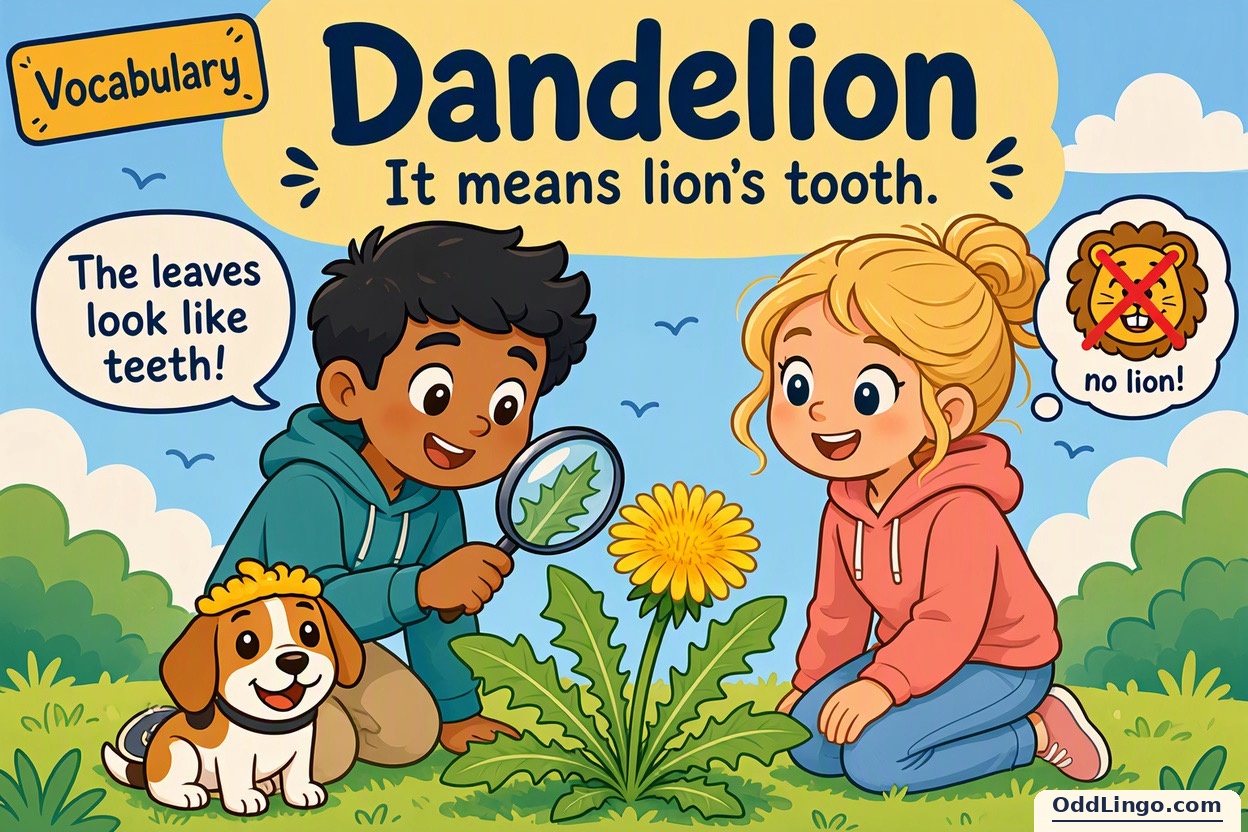
A dandelion is a common yellow wildflower, and its name means "lion's tooth". Learn how to say it, use it, and why a lion is in the name.
Wait... Where Is the Lion?
No lion lives in your garden, and the flower isn't dangerous. But the name really does hide a lion, and a tooth. The picture comes from the leaves, not the petals.
Lion? ❌
Tooth? ❌
A flower with leaves like a row of tiny teeth? ✅
What Does Dandelion Mean?
A dandelion is a wildflower with a bright yellow flower. When the flower finishes, it turns into a round, fluffy ball of seeds that blows away in the wind.
It's a noun, and you can count it: one dandelion, two dandelions.
There was a dandelion growing in the crack of the playground.
🔊 Pronunciation
DAN-duh-ly-un, also heard as DAN-dee-ly-un
The stress is on the first part: DAN. The last part sounds like "lion" with a soft un on the end.
dandelion
🗣️ Natural Examples
We picked a dandelion and blew the fluffy seeds into the wind.
The lawn was full of yellow dandelions after the rain.
My little sister made a wish on every dandelion she found.
Dad pulled the dandelions out of the garden, but they came back the next week.
🛠️ How to Use It
Dandelion is an everyday word. You can use it in conversation, in school writing and in stories, and everyone will understand it.
It's countable: a dandelion, three dandelions.
It's usually written with a small letter: dandelion, not Dandelion, unless it starts a sentence.
You can use it for the flower (the yellow part) or the whole plant.
🤝 Common Word Partners
a field of dandelions
dandelion seeds
dandelion fluff
dandelion clock (the fluffy seed ball, mostly in British English)
pick a dandelion
blow a dandelion
👯 Similar and Related Words
wildflower: a flower that grows by itself, not planted by a gardener. A dandelion is a wildflower.
weed: a plant that grows where someone doesn't want it. Some gardeners call dandelions weeds, but many children think they're lovely. The word depends on who's looking.
seed head: the round, fluffy part that forms after the yellow flower is finished.
⚠️ Common Mistakes
Spelling. It ends in -ion, just like lion.
❌ dandilion, dandylion, dandeleon
✅ dandelion
It's a flower, not an animal.
❌ A dandelion can bite, because it has teeth.
✅ A dandelion has jagged leaves that look like teeth.
💬 In a Conversation
Leo: Why is it called a dandelion? There's no lion. Mia: It means "lion's tooth". Look at the leaves. Leo: They do look like pointy teeth. Mia: Now you can't un-see it.
💡 The OddLingo Trick
Break the word into three parts: dan-de-lion.
Dan is the old French dent, the tooth, like in dentist. De means "of". And lion is the lion. So the name is tooth of lion.
Next time you see a dandelion leaf, imagine a lion's mouth with a row of pointy teeth.
🕵️ Where Does It Come From?
The name came into English in the late 1300s, from the French phrase dent de lion. That means "lion's tooth", and it was itself a translation of an older Latin name, dens leonis.
Dictionaries say the name is about the leaves. They have deep notches along the edges, so they look like a row of sharp, pointed teeth.
You can hear the French word dent ("tooth", said a bit like "dahn") at the start of dandelion. It comes from the same root as dentist, a person who looks after teeth.
Other languages made the same picture. German calls the plant Löwenzahn, and Spanish says diente de león. Both mean "lion's tooth" too.
🎯 Test Your Skill
No lions here. Just a yellow flower and a few questions.