⚡ Quick Meaning
If something is the tip of the iceberg, it's only the small part you can see, and there's a lot more you can't see.
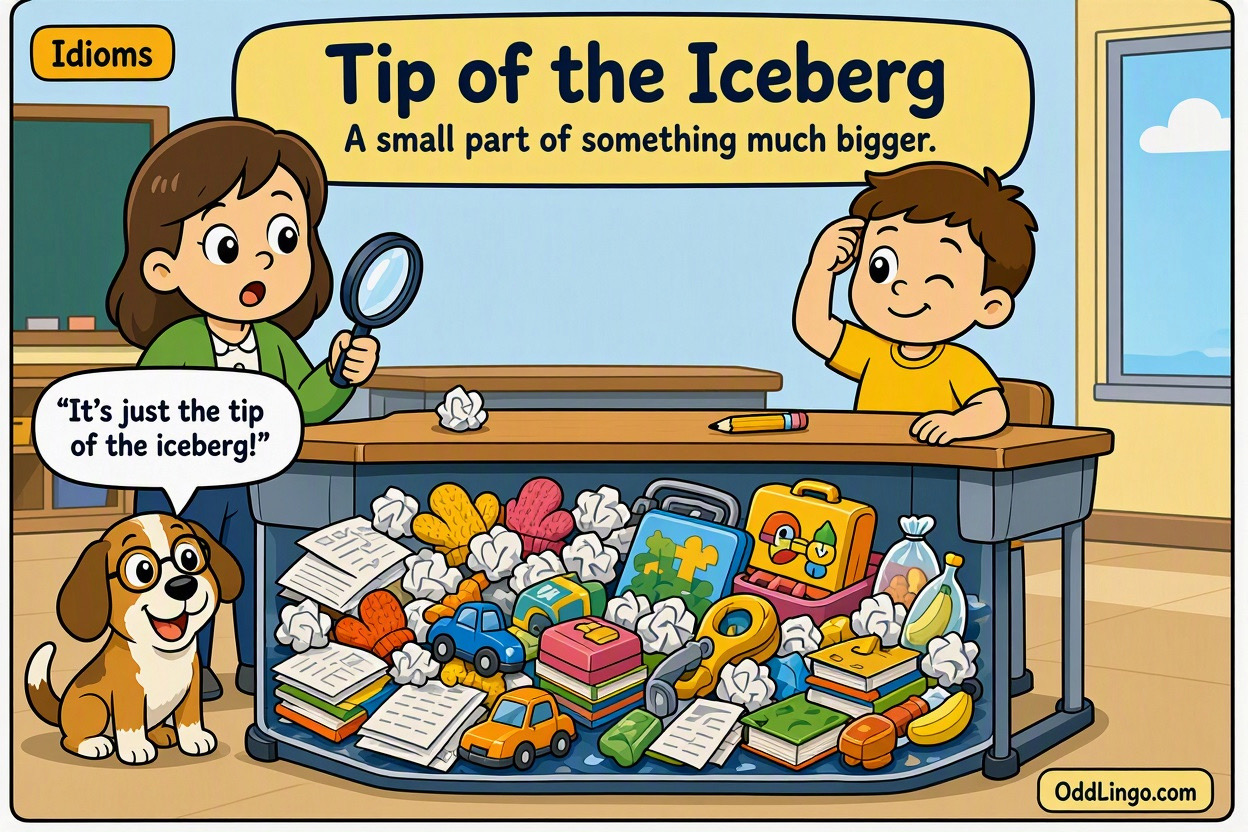
Only a pencil and a paper ball were on top of the desk, but they were the tip of the iceberg. Inside was a whole heap of forgotten things.
🧊 Wait... Why an Iceberg?
TIP OF THE ICEBERG = A SMALL PART OF A BIG THING?!
A tiny piece of ice? ❌
A tiny visible part of something huge? ✅
Here's the science behind the idiom: about 90 percent of an iceberg is underwater. Ice is a little lighter than seawater, so it floats, but most of it sits below the surface. All you see is the tip. The idiom uses that to mean "this is only the beginning".
It's also a fixed phrase. We say the tip of the iceberg, not "the top of the iceberg" or "the tip of the glacier".
🎬 Picture the Situation
Look at the picture. On top of the desk, there is only a pencil and one crumpled paper ball, so it looks tidy. Then the teacher looks inside with her magnifying glass. There are crumpled worksheets, mittens, toy cars and even a banana in a bag. The little things on top were just the tip of the iceberg.
🗣️ Natural Examples
The first missing homework was just the tip of the iceberg. Half the class had forgotten theirs.
My desk looks tidy, but the paper ball on top is the tip of the iceberg. The real mess is inside.
One broken swing is the tip of the iceberg. The whole playground needs a fresh coat of paint.
Her singing at lunch was the tip of the iceberg. She also plays four instruments.
The teacher said the questions we saw were only the tip of the iceberg of the test.
💬 In a Conversation
Teacher: I can only see a pencil and a paper ball on your desk.
Sam: That's just the tip of the iceberg.
Teacher: What do you mean?
Sam: The rest is inside. Please don't open the lid.
Teacher: Too late. I found three lunchboxes and a banana.
🧭 When Do You Use It?
- You see one example, and you know there are many more
- A problem looks small, but you think it's much bigger
- You want to say "this is only the beginning"
- You are chatting, or telling a story about something that turned out larger than you thought
🎓 Common Learner Point
It's about something hidden, not about size alone. The visible part is small, but the whole thing is big.
It's often used with just or only. That's just the tip of the iceberg. This sounds natural and emphasises how little you can see.
It isn't always bad news. Most examples are about problems, but you can also use it for good things: Her talent is just the tip of the iceberg.
Keep the word tip. The idiom is the tip of the iceberg, not "the top".
🕵️ Where Does It Come From?
The word iceberg came into English in the 1770s from the Dutch word ijsberg, which means "ice mountain".
The figurative phrase came much later. Many dictionaries give 1962 as the first example, but the researchers at Word Histories found earlier ones. In 1912, the American writer James Oppenheim used it in a magazine to say that the part of the mind we notice is only the tip of the iceberg, and the bigger part is hidden underneath. Other writers used the same picture in the next few years.
The phrase works because it matches the real fact: the part you see is small, and the part you can't see is large.
💡 The OddLingo Trick
Picture a small white triangle poking out of blue water. That's all you can see.
Now picture a gigantic mountain of ice hiding underneath. The tip is what you notice. The iceberg is what's really going on.
If something is out in the open, you can use a different idiom: the elephant in the room is a big thing everybody can see but nobody talks about. If you want one more idiom with a surprising picture, try storm in a teacup.