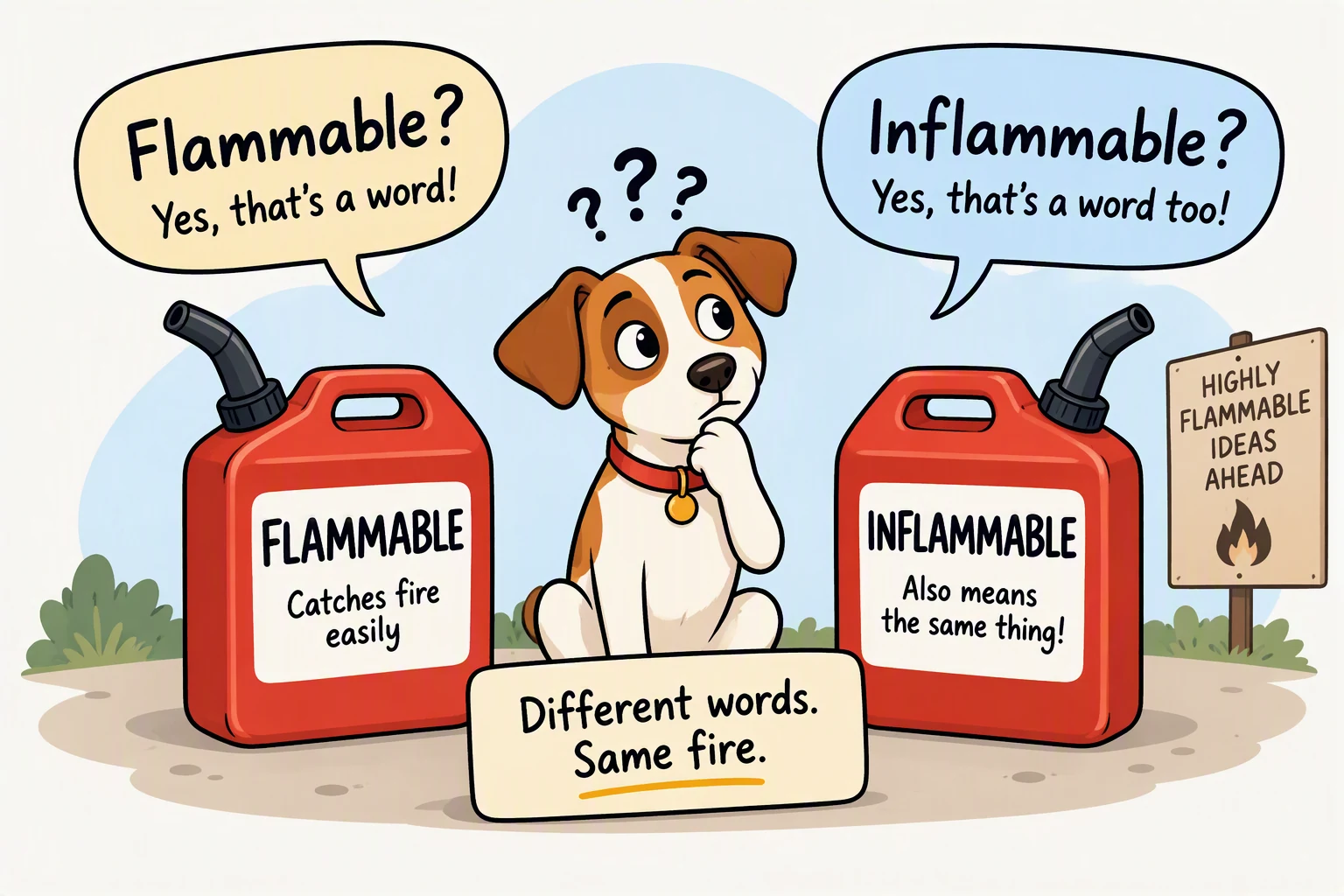
Flammable and inflammable look like they should be opposites, but they aren't — both mean something can catch fire easily. Only nonflammable means it can't.
- Flammable is about catching fire easily.
- Inflammable is about catching fire easily too, despite the "in-".
The weird part
Flammable 🔥 — catches fire easily
Inflammable 🔥 — catches fire easily
Nonflammable ✅ — does not catch fire easily
Flammable and inflammable mean the same thing. English looked at a safety warning and decided this was an excellent place for a vocabulary puzzle.
But doesn't "in-" mean "not"?
Often, yes:
inactive — not active
inaccurate — not accurate
invisible — not visible
So it's reasonable to assume in + flammable = not flammable.
Unfortunately, that's the wrong "in-". The one in inflammable isn't the negative prefix from words like inactive — it comes from Latin inflammare, meaning "to set on fire" or "to inflame". So inflammable was never built to mean "not flammable." It means almost the opposite of what its modern spelling seems to promise.
Good to know
Inflammable actually came first, appearing in English in the early 1600s. Flammable arrived later, in 1813 — leaving English with two words that look like opposites but mean the same thing.
Which one should you use?
Today, flammable is the clearer choice on warning labels and in everyday use, since the "in-" misleads so many readers. If something does not catch fire easily, the clear word is nonflammable. Inflammable is still a legitimate word, and you'll still see it — just remember the "in-" doesn't make it safe.
Natural examples
Keep flammable materials away from open flames.
The liquid is highly flammable, so store it carefully.
The material was chosen because it is nonflammable.
In a conversation
Sam: It says "inflammable."
Mia: Great. So it won't burn?
Sam: Actually...
Mia: Why are you backing away?
Common mistakes
It already means flammable.
❌ Inflammable means something cannot catch fire.
✅ Inflammable means something can catch fire easily — if you mean the opposite, use nonflammable.
Easy way to remember it
Forget trying to decode the "in-". When fire safety matters: flammable means fire. Inflammable? Also fire. Only nonflammable gives you the reassuring "not".
English had one job. Somehow we ended up needing three words and a warning label to explain it.